


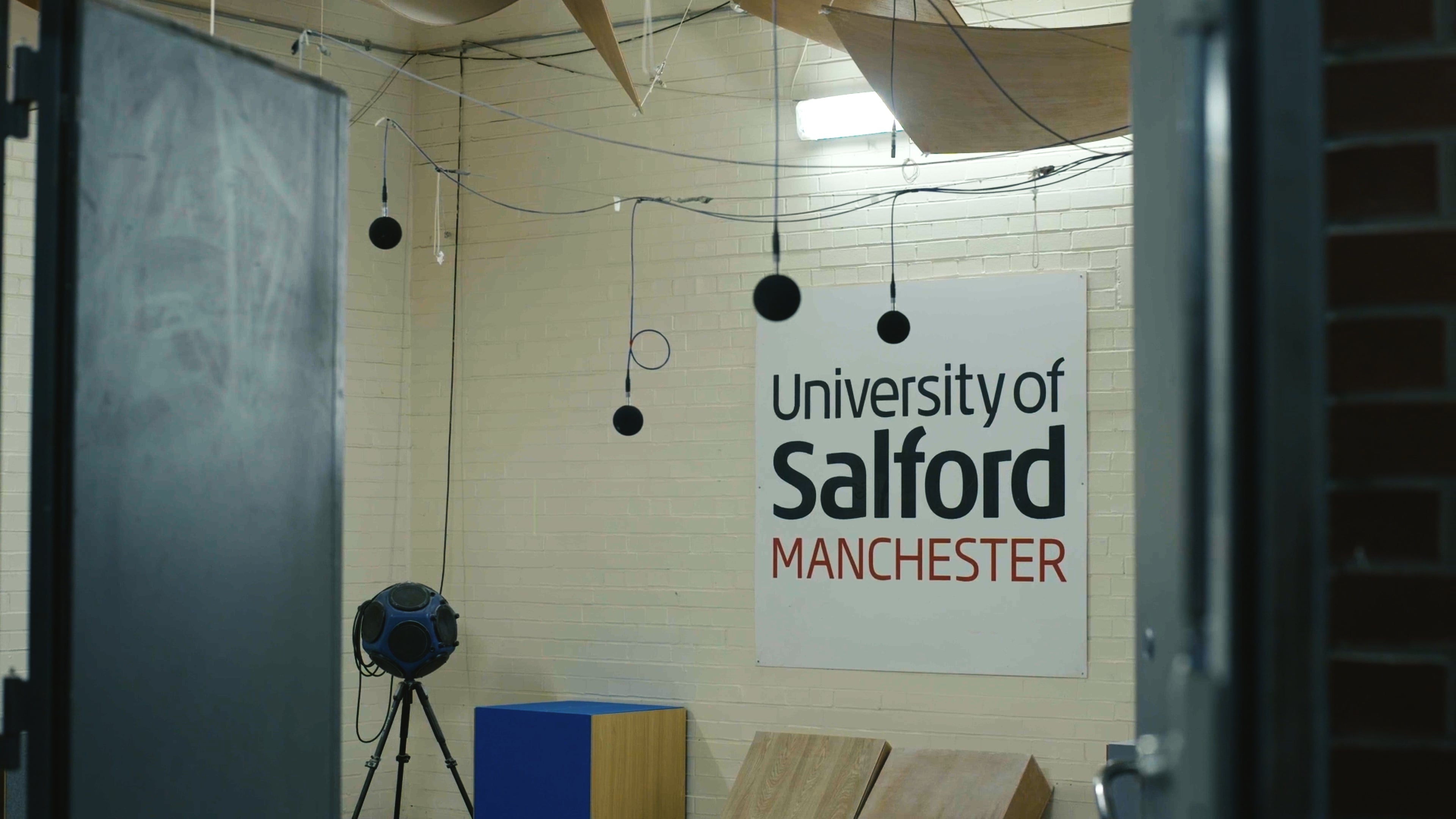
GIK Acoustics recently spent time at the University of Salford’s Acoustics Laboratories, one of the most respected acoustic research facilities in the world. The visit was not about marketing claims or chasing headlines or clicks. It was about science: measurement, methodology, and transparency. In short, it was about making sure that the performance data behind GIK products reflects both laboratory and real-world scenarios, reflecting how those products are actually used in real rooms.

Salford’s facilities are internationally recognized, not only for their technical capabilities, but for their role in shaping modern acoustic research. The labs are led by Professor Trevor Cox, one of the most influential acousticians working today, whose research and writing underpin many of the standards and test methods used across the industry. For manufacturers serious about performance rather than appearances, Salford represents a gold standard for independent validation.

Measuring Absorption the Right Way
One of the primary spaces used during GIK’s visit was the reverberation chamber at Salford’s facility. This room exists for a very specific purpose: measuring sound absorption. In its untreated state, the chamber is so reverberant that normal conversation becomes difficult. The room is designed to retain sound energy, making even small changes in absorption clearly measurable.

By introducing test samples into this environment, researchers can determine how much acoustic energy is removed from the room across different frequencies. This data forms the basis of standardized absorption coefficients, the figures often quoted on product data sheets.
But this is where methodology matters.
A common issue in acoustic testing is that standards are, by necessity, simplified. Traditional absorption tests assume relatively simple shapes placed in idealized positions, often flat on the floor and isolated in the middle of the room. While this makes comparisons possible, and GIK makes our standardized test data available, it does not always reflect how products are actually used in studios, listening rooms, or commercial spaces.
At Salford, GIK worked with the lab team to test panels in configurations that mirror real-world installations. That means measuring performance when panels are mounted or positioned the way users would actually deploy them, rather than placing them in unrealistic positions to simplify and the test and make the configurations repeatable.

The goal is not to “game” the standard. Quite the opposite. It is to understand how performance changes with placement, spacing, and orientation, and to present data that better represents real-world outcomes. along with the more familiar data from standardized testing procedures.
Pushing Beyond the Minimum Standard
Standards exist for a reason. They provide consistency and a baseline for comparison. But standards also have limits, especially when products fall outside the simple use cases those standards were designed around.
As the Salford team explains in the video, many companies are primarily interested in obtaining a single number, such as an NRC rating commonly used in non-audio-critical, normal construction applications. That number may be sufficient for basic, installations, but it often fails to tell the full story. When products are designed to be used in corners, spaced off walls, stacked, or combined with other devices in rooms where the sound has to be great from the low bass through the treble, a single flat-floor test doesn't always tell the full story.
GIK’s approach has been to push beyond the minimum requirements of the standard, not to discard it, but to put the test data into a more useful context. By testing different installation methods and comparing the results, it becomes possible to understand not just how much absorption a product provides, but how that absorption changes depending on how it is used.
This kind of work is more time-consuming and more complex than basic certification testing. It also produces results that require explanation rather than sound bites. But it is essential if performance claims are going to be meaningful rather than just technically defensible.
From Absorption to Isolation
Beyond absorption testing, the visit also highlighted Salford’s transmission suite, which allows researchers to measure how sound passes from one space to another. The suite consists of two rooms separated by a boundary, with extreme care taken to ensure that no sound travels between them except through the test sample itself.
This kind of setup is critical for understanding isolation performance, but it also underscores a broader point. Acoustic behavior is highly context-dependent. What works well in one application may be irrelevant in another. Measuring that behavior accurately requires environments that eliminate variables, so the results can be trusted.
Walking from the reverberation chamber into the anechoic chamber makes this contrast immediately obvious. Where the reverberation chamber exaggerates reflections, the anechoic chamber eliminates them entirely. There are no echoes, no room signature, and an exceptionally low noise floor. In this space, sound can be measured in isolation, free from the influence of boundaries.

Both types of rooms are essential for acoustics research applications, but it also reinforces an important idea for end users: measurements only have meaning when you understand the conditions under which they were taken.
Transparency Is Only Step One
Publishing test data is important, but it is not sufficient on its own. Acoustic measurements are not intuitive, taking time to learn to understand, especially for people new to room acoustics.
This is where interpretation becomes critical. Understanding what a test result means, and what it does not mean, requires experience. It requires an understanding of room behavior, decay times, placement, and the interaction between multiple devices in a space. Measurements tell you what a product can do under controlled conditions. Designers help you understand what that means for your room, your speakers, and your goals.
In addition to being committed to providing educational material about acoustics, we also offer free consultation with our team of experienced Acoustic Designers. We want everyone to choose the best acoustics solutions for their needs, so we provide these resources to everyone at no cost.

This combination of independent testing and guided interpretation is what turns data into useful information. It allows users to move beyond chasing numbers and instead focus on outcomes: clearer bass, more consistent decay times, better imaging, and a more trustworthy listening environment.
Testing Matters
Independent testing at facilities like the University of Salford serves a larger purpose than certification. It keeps manufacturers honest, pushes product development forward, and helps demystify acoustics for the people who rely on it every day.

For GIK, the Salford visit reinforces a long-standing philosophy: performance claims should be earned, not assumed, and data should reflect reality, not just compliance. By working with leading academic institutions and being open about both results and limitations, the goal is not just to sell products, but to improve how people understand and apply acoustic treatment.
In an industry where it is easy to hide behind simplified numbers, that commitment to rigor and transparency is what ultimately builds trust and delivers results. GIK Acoustics is committed to doing both.


Share:
Room Acoustics Primer
Early Reflections Explained