


GIK Acoustics’ Vice President of Acoustic Design, James Lindenschmidt, will present new work at the AES 159th Convention in Long Beach on October 23 at 4:00 p.m. The talk, “Modular, Shippable Acoustic Treatments for High-End Mastering Rooms: A Case Study with Adam Ayan,” shows how a high end mastering-grade room can be built with modular devices rather than permanent construction.
For years, world-class mastering has leaned on architectural builds: thick treatments hidden behind false walls, tuned elements, and custom geometry. Those rooms can sound great, but they are fixed in one configuration. As formats and workflows change, many studios need a different path that delivers a trustworthy listening environment while staying adaptable.
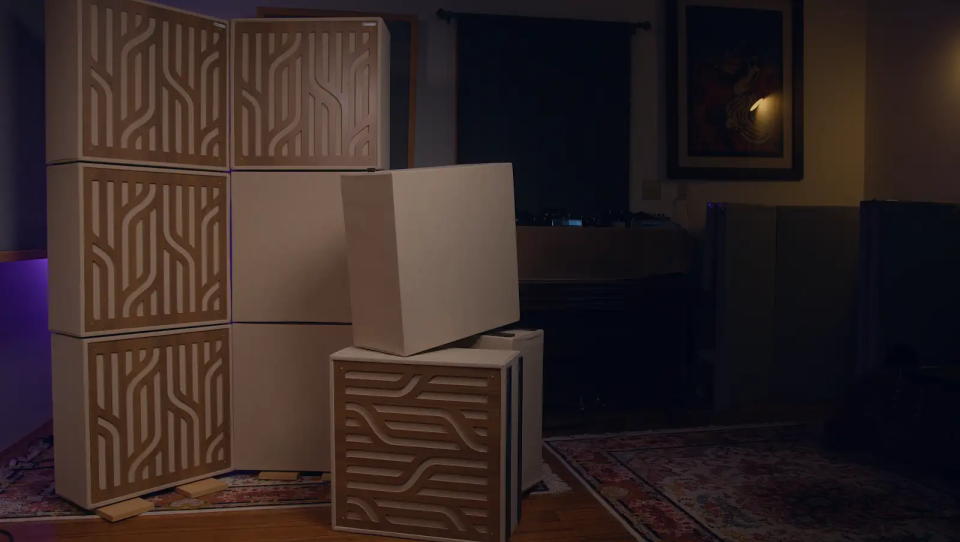
The case study centers on Ayan Mastering in Portland, Maine. Starting from room dimensions similar to Adam’s previous space at Gateway Mastering, the design used high-depth modular absorbers and hybrid elements placed in a distributed, spaced configuration. Corner volume was addressed with deep trapping; the front half prioritized early-reflection control; the rear combined diffusion and broadband absorption for a natural decay field.
What matters most is performance. Measurements from the finished room show:
-
Tighter low-frequency control with smoother response and decay times at all bass frequencies, with a ruler-flat Peak Energy Time between 60-200Hz, an essential range for modern music.
-
More consistent decay time behavior across the spectrum, with less problematic resonances in the bass range, and more consistent, controlled reverb/RT60 time through the mids & treble.
-
Highly controlled early reflections at the listening position for stable imaging and reliable tonal balance.
“These results confirm that a modular system can reach the precision we expect from a world-class mastering room,” says Lindenschmidt. “You get the performance you need and the flexibility to relocate, reconfigure, or expand without tearing into walls.”
The session will walk through the design approach, placement logic, and before/after data, including spectrogram comparisons. The goal is practical: show engineers how to achieve repeatable, mastering-grade performance using shippable components that can be deployed in different shells and updated over time.
Join us at AES Long Beach, October 23, 4:00 p.m. We’ll cover the full methodology, discuss limits and tradeoffs, and leave plenty of time for questions.
Share:
Summer Giveaway 2021 Vote
GIK Acoustics collaborates with Grammy-winning mastering engineer Adam Ayan on world-class new studio