


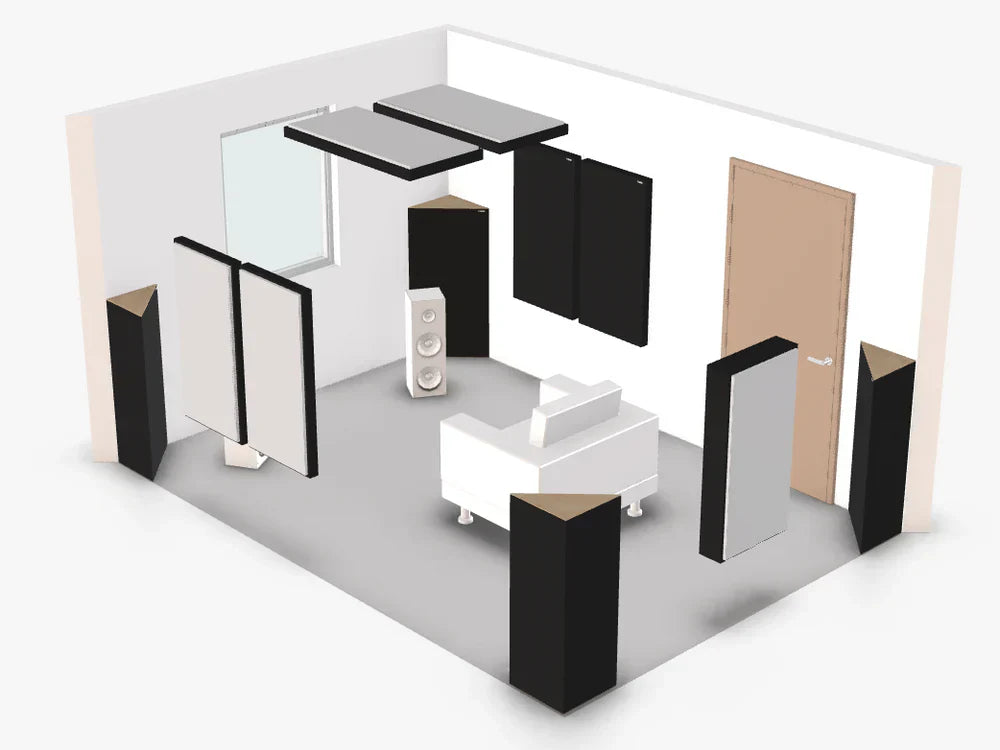
So you’ve got your room setup and treated, you’ve spent a ton on gear and a fantastic monitoring chain, but things still don’t sound right. Maybe the stereo image is weird, or the low end is tubby on one side and thin on the other. Is in the monitors? Is it the converters? Is in the way you’ve treated the room?
Often it’s none of those things. One of the most common issues we address in room setup has nothing at all to do with acoustic treatment, but it’s every bit as important. It’s the issue of monitor positioning, and if it’s done wrong the results are obvious and disturbing. Inaccurate positioning can result in all the problems listed above plus quite a few more. This applies to studios, 2-channel rooms and home theaters. Here are some of the most common problems I see:
- Speakers too close together: narrow stereo image. No real sense of where things are panned in the mix. Basically mono except for the most extreme-panned elements.
- Speakers too far apart: marked left/right localization (mix elements panned left/right are “stuck” there with no real sense of larger ambience). No real sense of mix depth, and in some cases no sense of a center-image. It extreme cases a sense of “big mono” where all elements of the mix are localized left and right with little or no center image.
- Speakers too low/too high: dull, muddy mid-range; source material sounds “shallow”. Speaker-under-a-blanket effect. Sound changes radically with small vertical head movements.
- Speakers unequal distance from the listener: marked comb filtering, the effect of which could be an ice-picky mids/highs or dullness in the mids/highs; localization in the left or right speaker
That’s not a comprehensive list; those are just the most common mistakes, and there are endless combinations of them that compound the issues. It’s very difficult to make any progress in terms of clarity until they’re fixed, so let’s start with a basic listening triangle in your room setup:
The right starting place is always an equilateral triangle, meaning that the speakers will be as far apart from each other as they are from you at the listening position. Usually this distance will start around 4′ or so, and between 5′ and 6′ is very common for studio listening spaces. Most 2-channel listening spaces start around 6′ and can be 12′ or more. Bear in mind that this is only the starting place. Individual preference plays a huge role here. For example, I personally prefer more depth in the center images with a little more emphasis on the hard-panned elements, so I’m a bit closer to my speakers than they are to each other (the speakers are 84″ apart and I’m 76″ from them). Other people prefer a more homogenous image, so they position themselves further from the speakers than they are apart.
The other part of the room setup is aiming. How far should we toe the speakers in? Are we aiming for the center of the head or a point slightly behind the head? The answer is, yes. Seriously, it can go either way. This is almost entirely based on preference and the specific acoustic characteristics of the space the speakers are in. The rule of thumb is that the speakers should be toed-in by about 30 degrees. Like all such “rules”, it’s meant to be broken. I’ve seen everything from 30 degrees to zero toe-in work just fine. Experimentation and the specific acoustic characteristics of the space will determine it.
Most importantly, take your time. You’re not going to get it done in a day. It can take weeks of working/listening on the system and the room setup to pinpoint things you’d like to change. If you start with the baseline equilateral triangle though, you have a solid place to work from. Remember to mark the position of the speakers or take pictures so you can re-set as accurately as possible. From there you can make preference-based decisions according to the data you gather while listening. When you get it right, you’ll know it.

Share:
Room Setup General No-No's
Do Foam Bass Traps Work? Comparing Acoustic Foam to GIK FlexRange Bass Trap Panels