


There are a lot of guides out there on how to construct soundproof walls and even some prebuilt solutions and DIY hacks. In this video we want to look at some of the basic strategies and options we have for setting up an isolation booth from the beginning. Starting with the option of whether to use an isolation booth at all.
Should You Use an Isolation Booth at All?
If you're not in a noisy environment, using a smaller room for recording can cause more issues than an isolation room might solve. Having a smaller room means that first reflections are going to be louder and happen sooner, so you're more likely to get comb filtering and smearing.
Smaller rooms have less room for treatment as well, so treating for lower frequencies is going to be a lot more difficult with no room for thicker panels.
Setting up a record zone in a large room might be an easier strategy for you and give you a better result. You can refer to our live room video for more info on how to treat a larger room for recording.
If you're stuck with lots of external noise, then isolating yourself from the unwanted sound may very well be worth the trade off that comes with recording in a smaller room.
Dimensions Matter
The first thing to consider when setting up an isolation booth is the dimensions. Many people might start with something like a 4 foot by 4 foot booth with an 8 foot ceiling. While having four walls with the same dimensions might make construction easier, the more symmetry in your dimensions the more certain frequencies will build up causing unwanted peaks and nulls in your frequency response. Changing the dimensions so that no two measurements are the same or are multiples of other measurements will drastically improve the room before we even get to absorption. So instead of 4 by 4 by 8 we may want to try something like 5 by 7 by 8.
Airtight Construction
Remember the primary purpose of an isolation booth is to isolate a recording from the sound outside of the booth, so a good isolation booth should be as airtight as possible. Anywhere air can freely pass into the room, so can sound. Keep this in mind when you're figuring out how to run your cables and mount the door to the booth. An airtight room will also require ventilation if you don't want your talent to pass out from lack of oxygen or heat exhaustion.
Absorption
For absorption, you'll want a treatment rated low enough to absorb the full range of human speech which can resonate below 100hz. An isolation booth used for vocals could use our FlexRange® Bass Trap Panels to line the walls and ceiling. If you plan on using your room to record bass heavy instruments you'll want to look into something thicker.
The more absorption coverage we work into the room the better as we're not going to get any beneficial effects from the room's natural characteristics. Even the floor should be covered with a rug and carpet.
Hybrid Diffusion Options
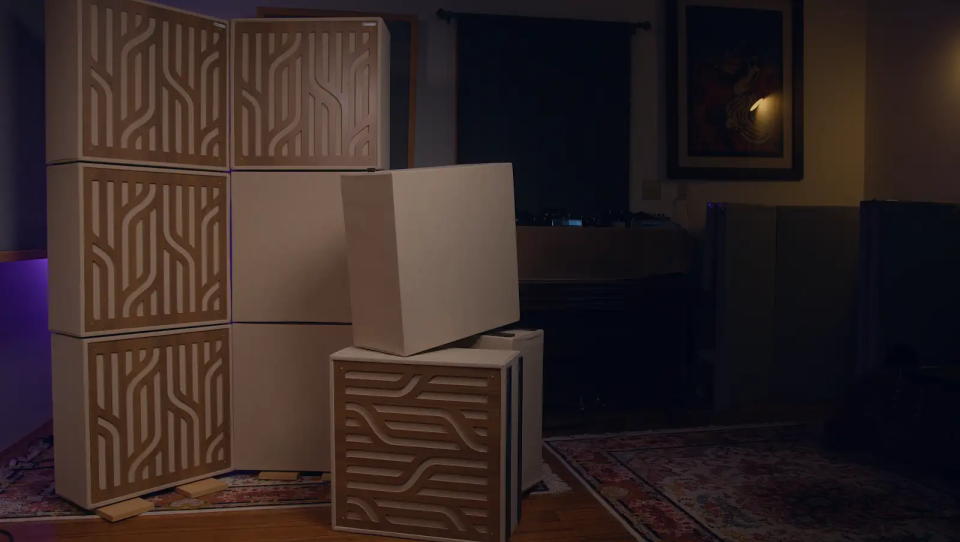
Isolation booths aren't just for vocals and haven't always been the small closet sized rooms we see in home studios. For acoustic instrument recording in small booths we might also consider some types of hybrid diffusion, such as our Amplitude™ Acoustic Panels.
There’s more than a few ways to set up an isolation booth, so if you’re still unsure what strategy is best for you, fill out our free acoustic advice form for a personalized consultation.
Share:
The Basics of Room Acoustics
Treating First Reflections