


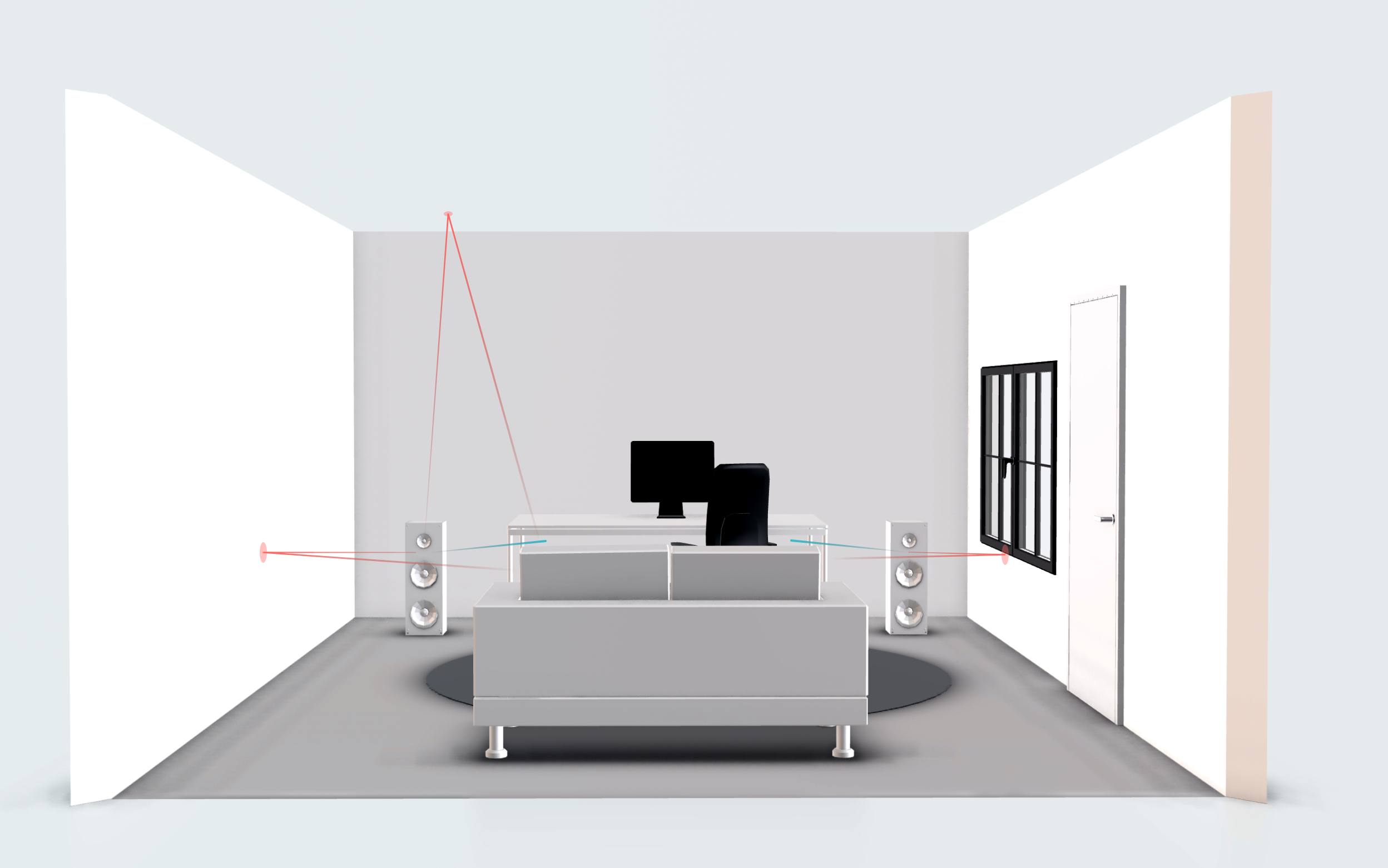
Speaker Boundary Interference Response (SBIR) is one of the most important—and misunderstood—factors in room acoustics. For anyone setting up a home theater, listening room, or recording studio, knowing how speaker placement affects frequency response is critical to getting a clean, detailed sound. In this article, we’ll break down what SBIR is, why it matters, and how to position your speakers to reduce its negative effects.
What Is SBIR?
SBIR (Speaker Boundary Interference Response) is a term to describe how the proximity of a speaker to a hard boundary (wall/ceiling/floor) will change the response, especially in the low end. This is something that not a lot of people understand nor consider when planning a room.
Sound radiates from a driver in different ways. Higher frequencies act like a ray and move in straight lines from a point. As you get lower in the spectrum, they begin to radiate more like a sphere. By the time you get below 500 Hz or so, you’re getting pretty spherical radiation. By the time you get to 125, it’s purely spherical.
That said, imagine sound coming from a driver at say 100 Hz that is coming directly at you. There are other waves that are wrapping around the cabinet and bouncing off the front wall and then back at you. When 2 waves of the same frequency meet in this way (one direct, one having bounced off the front wall) there is an interface of the 2 waves (some describe this as interference).
How it works
Constructive interference occurs when the 2 waves happen to be in phase with each other. This yields a reinforcement of that frequency or a peak in response. Destructive interference occurs when the 2 waves are 180 degrees out of phase. This yields a partial cancellation of that frequency (the bounced wave has less amplitude) resulting in a dip or null at that frequency

This can cause WILD variations in frequency response. However, one can sometimes use this to your advantage. If you play with speaker positioning in relation to the front wall (behind the speakers) and the side wall, you can ‘tune’ the response changes. This can be beneficial when attempting to smooth overall response.
Let’s say that you have peak at your listening position at a given frequency. If you can find a place that images well and works with the video positioning that will create a slight dip due to SBIR, the net effect is a smoother response at your seat. It’s kind of like using an EQ without having to put one in your system.
Generally, your best off if the distance from speaker face to front wall, driver centers to side wall, and driver center to floor are 3 different dimensions in order to not reinforce any specific set of harmonics by having all the boundaries generate the same SBIR effect.
If you still have issues, you can treat the walls directly beside and/or behind the speakers with appropriate materials to further reduce the intensity of the reflected wave to it’s impact when interacting with the direct wave is minimized. If you have issues say from 125Hz up but OK below that, then a thinner panel may be in order. If you have problems all the way down, then something thicker may be appropriate.
Also remember that there will be interactions between the sub and boundaries and also between the sub and mains and their boundary responses.
Tools to Help
If you’re unsure where to start, try using tools like Room EQ Wizard (REW) to measure your room’s actual response, or consult a tutorial or SBIR calculator online to model the interaction of your speakers with nearby boundaries. That data can help determine whether you’re suffering from SBIR effects or broader room acoustics issues like room modes. It will also give you data on how other aspects of the system, like high frequencies, are performing.
Our team at GIK Acoustics offers a Free Acoustic Advice service to help you design the ideal setup based on your specific room. Whether it’s a small room, home theater, or recording studio, we’ll guide you through the best speaker placement, treatment strategy, and product recommendations.
When in Doubt, Ask for Help!
Understanding Speaker Boundary Interference Response (SBIR) is a vital step in optimizing your sound system. While placement alone can’t fix everything, smart speaker positioning—paired with strategic acoustic panels, bass traps, and room treatments—goes a long way in achieving balanced, powerful sound.
By avoiding critical distances and minimizing destructive interference, you can ensure your direct sound reaches the listener cleanly, and the reflected sound is properly managed. Don’t let your setup suffer from a preventable frequency response dip—start with solid placement, treat the room, and enjoy the full potential of your amplifiers, subwoofers, and speakers.
Need help with your project? Let us know. We’re here to help you unlock the sound your room was meant to have.

Share:
What Are Room Modes
Why Isolation (Soundproofing) is Important