



A Behind-the-Scenes Look at the GIK Consultation & Design Process
When people ask what the GIK consultation process actually looks like, Zach Adams’ Nashville studio is a strong example because it reflects what many of our clients are doing. Zach is a professional producer and recording engineer working out of his home in a dedicated room.
This wasn’t an empty spare bedroom with a laptop and a pair of speakers. It was already a solid project studio with good equipment and some initial treatment in place. In many respects, it was already above average. But like most small rooms, it had a predictable weakness: low-frequency control.
And in small-room acoustics, the low end is usually where clarity is either gained or lost.
This project gave us the opportunity to show, step by step, how we approach a real working room for an audio professional. Not an idealised diagram. A real space with angled ceilings, windows, doors, aesthetic preferences, and multiple functions.
Here’s how we tackled it.
Starting With Goals
Before talking about products, we talked about outcomes.
Zach’s room serves several purposes. It’s a writing space for co-writes, a tracking room for vocals and overdubs, and a production and mixing environment. That combination shapes every design decision. A writing room cannot feel oppressive. A tracking room cannot sound boxy. A mixing room must be trustworthy enough that decisions hold up outside the space.
Zach also cared deeply about the atmosphere and vibe of the space. He wanted the room to stay bright and open. He had intentionally chosen white panels and liked the lighting as it was. The design needed to support that clean, calm aesthetic rather than turn the space into a dark, over-absorbed environment.
A studio is both a technical tool and a creative environment. If it feels heavy, workflow changes. So from the beginning, the goal was a room that felt open but performed at a high level.
Building an Accurate Model
Serious acoustic design begins with geometry. We measured wall widths, ceiling heights, the break in the ceiling slope, window placements, door dimensions, and sill heights. Those numbers were entered into a Roomle model to create a precise 3D representation of the space.
The model does not need to be elaborate. It needs to be accurate. Even a simple box with correct dimensions gives us a reliable foundation. Combined with photos of the room, it provides enough context to make informed decisions about placement and coverage.
This is something we emphasise often. A basic drawing and a handful of photos are enough for us to move forward with confidence. But the Roomle software allows us to get quite precise, so long as care is taken to create the drawing in accord with the room’s dimensions and layout.
Once we had the room modelled, the acoustic priorities came into focus.
The Low-End Challenge
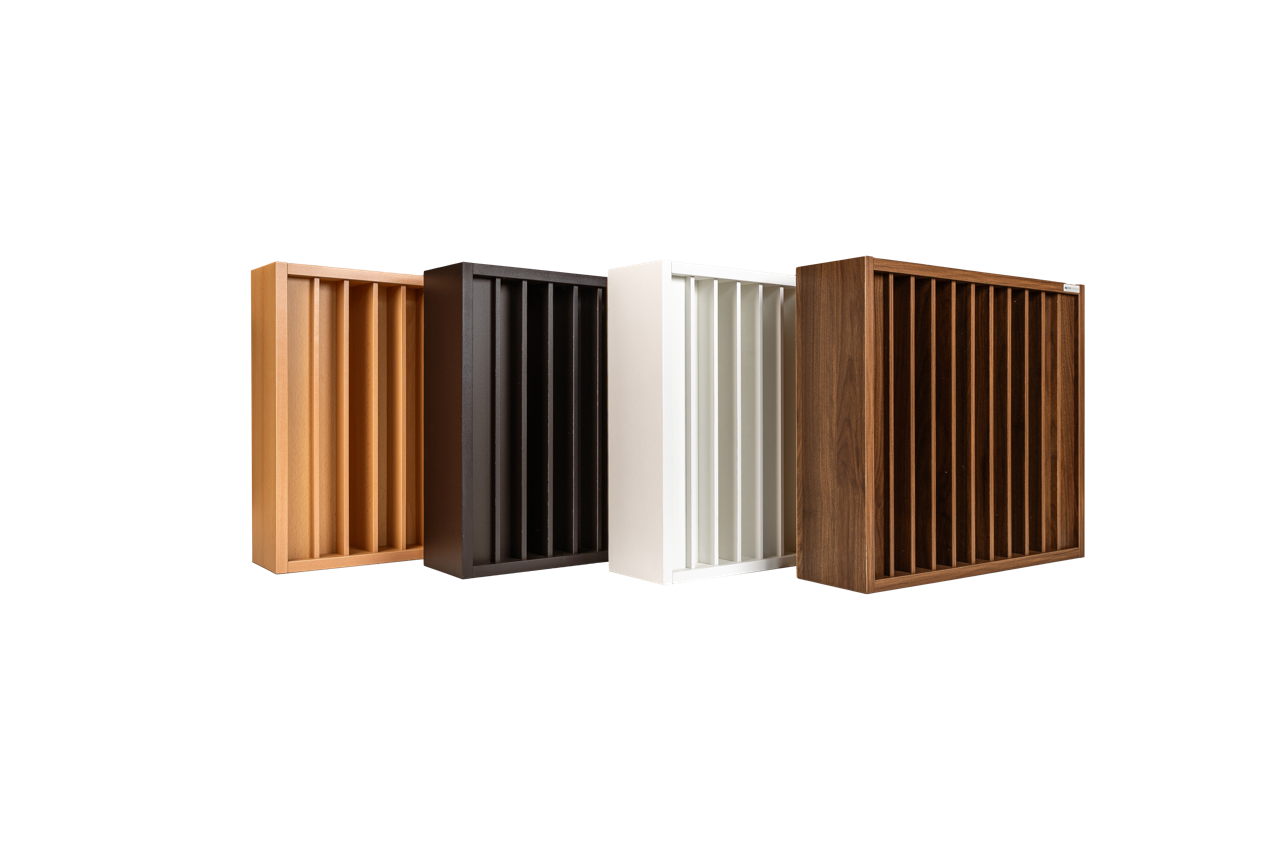
Zach already had six FlexRange Acoustic Panels (formerly called 242s) and a Screen Panel on hand that he wanted to incorporate into the new design. That meant midrange and treble reflections were partially controlled. The room was not overly live. But there was no bass trapping or diffusion.
In small rooms, bass issues are not primarily about frequency response graphs. They are about decay time. When low frequencies linger longer than everything else, the room sounds muddy and inconsistent. Kick drums lose punch. Bass lines blur together. Mix decisions become guesswork.
Controlling that behaviour requires adequate coverage (enough surface area) with panels of sufficient thickness to deliver the desired low end performance. There is no substitute for depth when dealing with low frequencies.
Which brings us to space.
Corner Bass Trapping
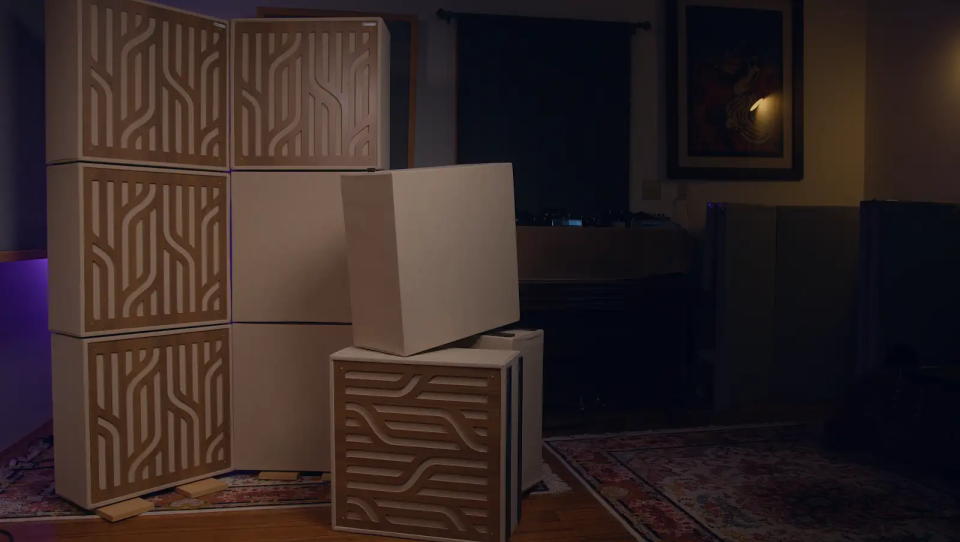
We stacked Soffit Bass Traps in all four vertical corners. These devices are 17 inch thick powerhouses. Stacking them floor to ceiling in all four corners sets you up for outstanding deep bass performance.
Corners are pressure zones. When bass builds up, it concentrates there. By stacking soffits floor to ceiling, we maximise absorption exactly where it is most effective. For rooms that need outstanding low end accuracy, the space used by these devices delivers. When the goal is clarity and reliable low-end decisions, investing this kind of space in the corners for bass trapping is one of the most efficient moves you can make.
This is the bass-versus-space tradeoff in practical terms.
Early Reflection Control
With corner trapping established, we turned to the mix position. Early reflections from the sidewalls and ceiling blur stereo imaging, create fatiguing harshness in the midrange, and smear upper bass clarity.
On the right wall, we stacked four 70Hz FlexRange Bass Trap Panels vertically, creating a thick absorptive zone beside the listening position. On the left wall, a window limited mounting options, so we used square panels fitted around the available space and deployed the portable Screen Panel in front of the glass during mixing. Movable solutions like this are very useful in project studios. They allow control during critical listening while adding additional flexibility for tracking sessions, just by moving the panels around.
Above the mix position, we installed four thicker panels on the ceiling. These panels eliminate ceiling reflections and extend absorption into the lower bass range. Thick panels at reflection points do more than reduce mid and high-frequency bounce. They help smooth the 70 to 200 Hz region, which plays a major role in punch and definition. When that range is uneven, mixing becomes a constant compensation exercise. When it is controlled, decisions come faster and with more confidence.
Front Wall Strategy
We installed two 70Hz FlexRange Bass Trap Panels on the front wall and fitted them with Range Limiters.
High-frequency absorption is the one area where restraint is necessary when there are more than a few panels in the room. Too much treble absorption can make a room feel dull or unnatural. Range Limiters increase bass absorption while reducing treble absorption. That allows the front wall to contribute strongly to low-frequency control without making the space feel overly dead.
The result is a room that retains brightness and openness while improving low-end definition. Conversation still sounds natural. The creative energy of the space remains intact. This is a balanced treatment strategy in action. The goal is not maximum absorption everywhere. The goal is controlled, even decay across the spectrum.
Rear Wall and Hybrid Panels
In the rear of the room, we shifted from pure absorption to hybrid control using 80Hz Amplitude Bass Trap Panels (formerly Alpha 6As).
Alpha panels combine broadband absorption with scattering and diffusion. On the rear wall and side areas, we used 1D diffuser plates for both performance and aesthetic continuity. On the ceiling, we installed two more 80Hz Amplitudes with 2D diffuser plates. Ceiling reflections can arrive from multiple angles, and 2D diffusion disperses energy more evenly in both horizontal and vertical planes. This approach keeps the rear of the room lively without introducing uncontrolled reflections.
For vocal tracking and acoustic instruments, that balance is important. Too much absorption can make the room feel small and closed in. A hybrid approach preserves a sense of space while keeping decay times under control.
Speaker Placement and Fine-Tuning
We intentionally left flexibility at the front wall to allow for speaker placement fine-tuning once treatment was installed. In small rooms, speaker placement has a major impact on nulls in the 70 to 200 Hz region due to SBIR (Speaker Boundary Interference Response), related to the distance between speakers and nearby surfaces. That upper bass range influences how kick drums and low-end instruments are perceived. Often, speakers perform best very close to the front wall, but the exact distance is best determined with a bit of experimentation.
The Result
After installation and tuning, the room behaves differently. Low-frequency decay becomes more even. Early reflections are reduced. Upper bass clarity improves. The room feels controlled but not sterile. Bright but not harsh. Comfortable enough for long sessions yet precise enough for serious mix decisions.
Most importantly, the space becomes trustworthy.
When decay times are balanced and bass is controlled, what you hear is something you can rely on. Decisions carry outside the room. Translation improves. Workflow becomes smoother. And once your ears settle into the new acoustic signature, the treatment fades into the background. You stop thinking about panels.
You just get back to making music.

Share:
Caso di studio: Progettazione di una sala di masterizzazione di nuova generazione per Adam Ayan
Updating Mapa Studios with acoustic treatment from GIK Acoustics