


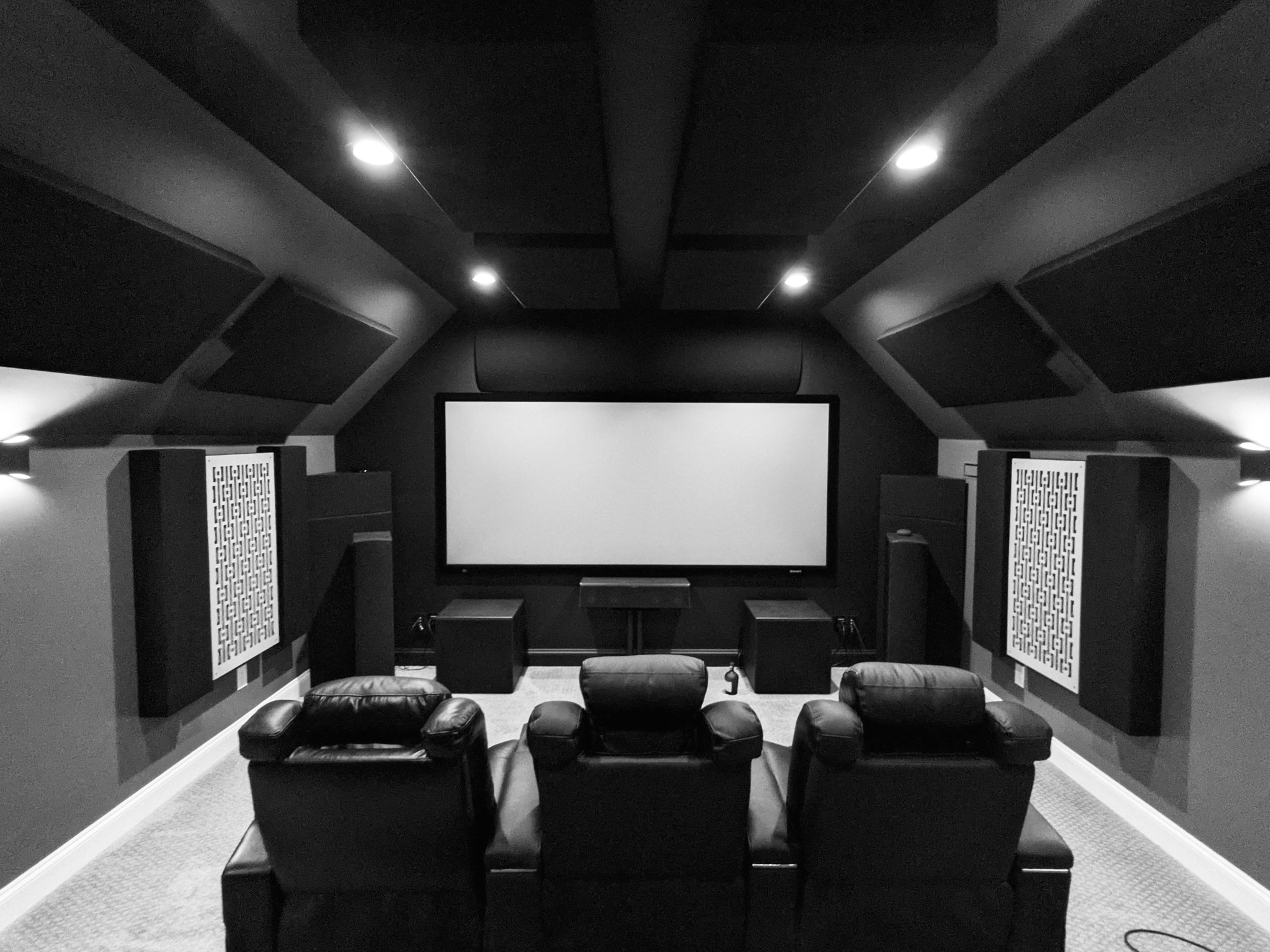
The quality of your home theatre experience is dictated by the interaction between your speakers and your room. While high-end sound systems provide the potential for greatness, the room acoustics decide whether that potential is realised or lost to distortion. Improving a media room isn't about making it louder; it is about managing sound waves in the time domain to ensure dialogue clarity, localised surround sound stage focus and coherence, and tight, impactful low-frequency performance. By strategically using acoustic panels, bass traps, and diffusion, we prevent the room from adding its own character long after the speakers have stopped, creating a trustworthy listening environment for every seat in the house.
Why Acoustics Matter in a Home Cinema

Most homeowners and audiophiles spend months researching the perfect processor or subwoofers, only to place them in a room that actively fights the signal. A typical living room or home cinema room is a box of hard, reflective surfaces. When your speakers fire, the sound hits these surfaces and bounces back into the room at different intervals.
These reflections cause three primary issues:
-
Smearing: Reflected sound arrives at your ears milliseconds after the direct sound, blurring dialogue clarity, intelligibility, and creating harshness and listener fatigue.
-
Reverberation: Sound energy builds up and lingers, creating a muddy wash that masks fine details.
-
Bass Resonances: Low frequencies resonate between room boundary surfaces, causing deep bass frequencies to sound inconsistent: frequencies are boomy in one seat and nonexistent in another.
In a professional cinema, the room is designed to disappear. In a residential media room, the room by default greatly affects what you hear because it keeps sounding after the speakers stop. Acoustic treatment is not an optional upgrade; it is the final, critical component of the signal chain. By hearing accurately, the sound is more engaging and evocative, and long listening or marathon viewing sessions do not get fatiguing.
Understanding Your Home Cinema Room

Every room has a sonic signature determined by its room dimensions, shape, and the layout/setup of the speakers, seats, and other objects. Physics dictates how sound waves behave based on the volume of air and the distance between boundaries, determining how the sound moves through the air, reflects off surfaces, and diffracts around objects over time once the energy leaves the speakers.
Room Size, Shape, and Dimensions
Small rooms struggle with low-frequency pressure. In a confined home cinema, bass waves are often longer than the room itself, leading to massive peaks and nulls in the response and longer decay times where the resonances are. Larger rooms may have fewer bass pressure issues but suffer from excessive reverberation times, making the home cinema experience feel cavernous and distracting. Whether you are a DIY builder or working with a designer, understanding that room size dictates the thickness of the treatment required is essential.
Listening Position and Seating Layout
In a home studio, we often focus on a single sweet spot. However, most home cinema acoustic strategies must account for multiple rows of theatre seating. The listening position is still our reference point, but we must expand our strategy to ensure the "money seat" is perfect without leaving the rest of the family in an acoustic jumble zone. Placement of seating relative to the back wall is especially critical; sitting too close to a boundary results in unnatural bass boost and harsh early reflections.
Core Acoustic Treatment Elements

Effective acoustic design relies on a balanced approach using three elements: broadband absorption, bass trapping, and diffusion.
Acoustic Panels for Reflection Control
Acoustic panels are designed to reduce the energy of mid and high-frequency reflections. We can also use Panel Bass Traps for even better performance and balance to extend that mid and treble absorption down into the bass region. While these panels in early reflection zones have a very specific role for mids and highs, making them thicker helps us in additional ways.
While many people focus on first reflection points, in a multi-seat theatre with a complex surround sound layout, reflection points become reflection zones. With multiple seats, and as many as 11 or more speakers in a modern ATMOS system, there are too many reflection points to keep straight.
We treat the side walls and ceiling, between the seats and the front L-C-R speakers, to bring the soundstage into focus, to sharpen the phantom centre, and improve the localisation of surround effects.
Bass Traps and Low-Frequency Control
Bass traps are the most misunderstood and neglected part of home cinema acoustics. Low-frequency energy is massive and powerful; the web of standing waves, nulls, and resonances created in a room makes the theatre experience inconsistent from place to place and inaccurate.
To control bass, you need coverage area and depth: the more thick panels we get into the room, the better the bass will become. Space is the currency of low-frequency control. Deep broadband bass trapping in the corners or on the back wall is required to catch the long waves before they bounce back and cancel out the next beat. Without this, your expensive subwoofers will sound slow and disconnected. Even in modest systems, bass control is the difference between hearing a film and feeling it with precision. In rooms where great bass sound is important, every acoustic panel in the room should be as thick as possible.
Diffusion for Spaciousness and Immersion
Diffusion doesn't remove sound energy; it scatters it. This breaks up distinct echoes without making the room sound dead, leading to a more balanced end result that is neutral, natural sounding, and a pleasure to listen and spend time inside. Diffusion panels are excellent on the rear walls, especially in larger rooms. Hybrid bass trap/diffusers can be used just about anywhere in a theatre as they have a very balanced sound inherently. Diffusers help the surround sound speakers feel more immersive, creating the illusion of a much larger space.
Sound Absorption vs. Soundproofing

One of the most common misconceptions is the confusion between acoustic treatment and soundproofing.
-
Acoustic Treatment: Bass traps, broadband absorbers, and diffusers improve the sound quality inside the room. It makes your speakers perform better.
-
Soundproofing: Prevents sound from leaving or entering the room. This is a structural process involving heavy construction using very specific techniques like adding mass, airtightness, and decoupling wall, ceiling, and floor assemblies.
Sound-absorbing panels will not stop your neighbour from hearing your film, though they can muffle things a bit in some situations. If you need to keep the peace, you need a contractor and a good design with soundproofing techniques. If you want to hear the wood snap in a forest scene or better dialogue intelligibility, you need acoustic treatment solutions.
Designing an Effective Home Cinema Treatment Strategy
We don't treat rooms randomly, though if you do put up the right panels randomly around the room it will still help quite a bit if you have enough of them. But we can optimise results in your theatre if we treat them strategically based on zones.
In a high-channel-count environment, we move away from treating isolated "points" and instead focus on treating strategic zones. Here is how to approach your room, step-by-step, using the right tools for each area.
Corners: The Foundation of Bass Control

Low-frequency energy naturally congregates in corners. To control the "boom" and ensure your subwoofers sound tight and impactful, you need to use the largest and thickest corner devices your room can accommodate. Space is the currency of bass control; the deeper the trap, the lower the frequency it can reach.
-
Best Performance: The Soffit Trap is our most powerful solution. It provides massive absorption depth and should be your first choice for front and rear corners if space allows and best deep bass performance is a goal.
-
Aesthetic & Performance: The Turbo Trap offers excellent low-end absorption with a rounded, columnar look that fits many modern theatre designs.
-
Small Footprint: If space is tight, the Tri-Trap is a stackable corner unit that takes up half the corner space but remains highly effective. For a more decorative finish that also scatters high frequencies, look at the Corner Amplitude Series.
Side Walls and Ceiling: Early Reflection Zones
The area between your speakers and your seating is the most critical for dialogue clarity and surround sound localisation. To stop sound waves from bouncing off these surfaces and smearing the audio, you must use thick absorbers. Thin panels only catch high frequencies, leaving the "mud" of the lower-midrange untouched.
-
The Pro Approach: Use 90Hz FlexRange Panel Bass Traps or 70Hz FlexRange Panel Bass Traps on your side walls. Thicker is always better for accuracy.
-
The Ceiling: Do not ignore the "hard floor" above you. Mounting these same thick panels as an acoustic cloud is essential to prevent the ceiling from collapsing your soundstage.
-
Hybrid Option: If you want to keep the room from feeling too "dead," use Amplitude Series panels in these zones. They provide the necessary thick absorption while the faceplates maintain a natural sense of air.
The Rear Wall: Diffusion and Immersion
The back of the room is where we create the sense of being "inside" the film. If you over-absorb the rear wall, the room feels small and the surround effects lose their sense of space.
-
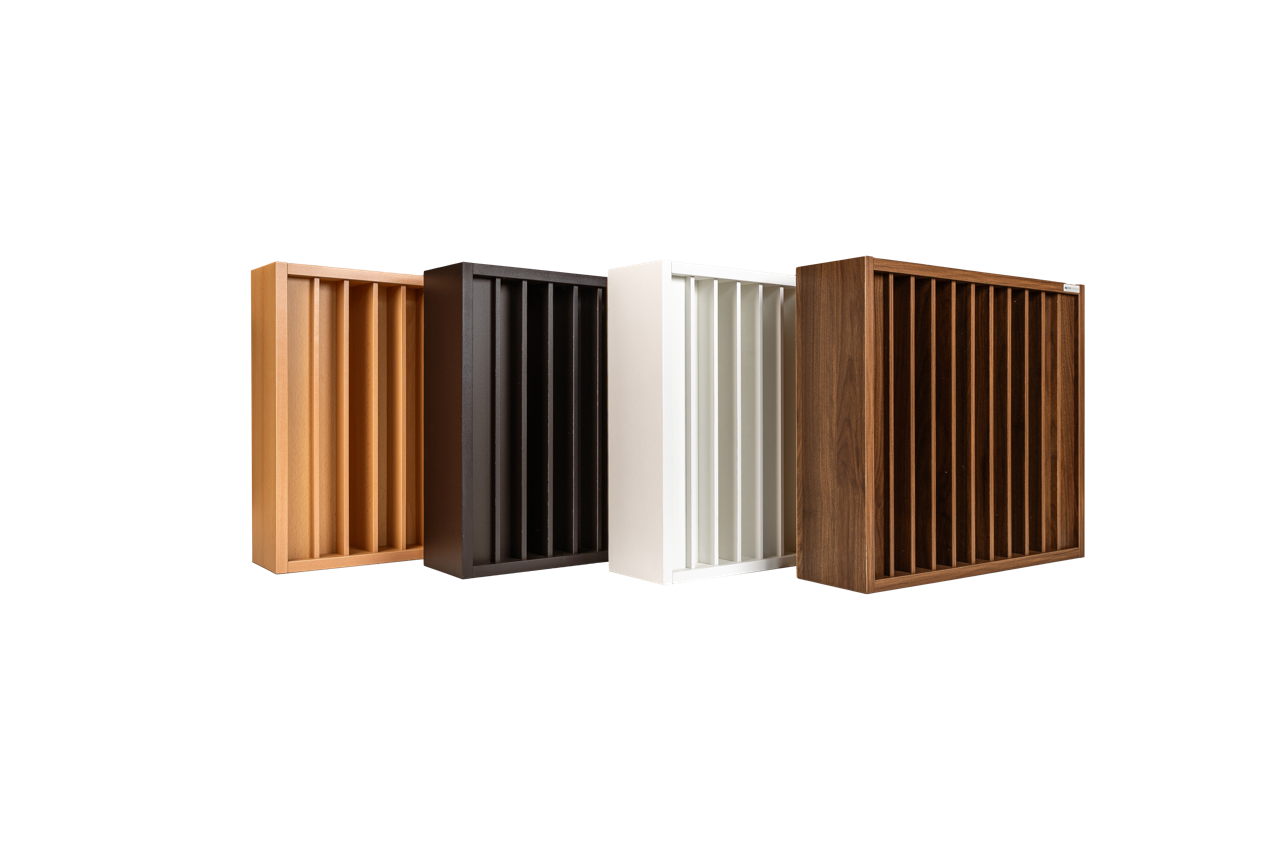
The Strategy: Use thick hybrid devices. The SlatFusor or the Amplitude Series are perfect here. They are deep enough to provide significant bass trapping (crucial for rear-wall buildup) but feature built-in scattering and diffusion. This breaks up echoes while keeping the energy from your rear speakers lively and immersive.
The Front Wall: Bass Trapping and Balance

The wall behind your screen and front speakers often causes "boundary interference," which can make your expensive LCR speakers sound thin or uneven.
-
The Solution: Cover as much of the front wall as possible with thick absorption. To avoid removing all the high-frequency energy in the room, use Range Limited (RL) versions of our 70Hz FlexRange Panel Bass Traps or 90Hz FlexRange Panel Bass Traps. Or the thicker 50Hz FlexRange Panel Bass Traps perform best when there is space.
-
Why Range Limited? These specialised traps include an internal membrane that reflects some high frequencies back into the room while allowing the troublesome low-mid and bass frequencies to pass through and be absorbed with a bit more efficiency. This ensures your front stage stays punchy and powerful without making the room's overall ambiance sound dull.
Subwoofers and Bass Integration
Using subwoofers, especially multiple subwoofers with intelligent placement, can help flatten the bass response across multiple seats. However, the room will still ring unless you have the physical volume of bass traps to absorb that energy. It's a great strategy for superior bass, but it does not replace the need for bass traps.
Common Home Cinema Acoustic Mistakes to Avoid
-
Treating randomly: Placing sound panels where they look good instead of where they are physically needed.
-
Ignoring bass control: Assuming your bass can be fixed by EQ/DSP or subwoofers alone without physical bass traps.
-
The thin foam trap: Using materials that only absorb high frequencies, leading to a dead but muddy room.
-
Neglecting seating: Placing chairs directly against the back wall where bass pressure is at its peak.
Better Sound Starts with Better Acoustics
The ultimate goal of any home cinema is immersion—the feeling that the walls of the room have disappeared and you are inside the film. That feeling is impossible in an untreated room where reflections and reverberation are constantly reminding your brain of the physical boundaries.
When you invest in acoustic treatment, you aren't just buying wall panels; you are buying the ability to hear your sound system as the director intended. Whether you are an audiophile or just building a comfortable media room for the family, the room is the one component you cannot afford to ignore.
Ready to Build the Cinema of Your Dreams?

Acoustics is complex, but you don't have to navigate it alone. Whether you are setting up a home cinema or a high-end listening space, GIK Acoustics provides the expertise to help you make correct decisions based on physics, not trends.
If you're ready to stop guessing and start listening with confidence, submit your room details for a free acoustic consultation and fill out our acoustic advice form.

Share:
Updating Mapa Studios with acoustic treatment from GIK Acoustics
How Thick Should Acoustic Panels Be?