



There is one question that runs through every bass treatment decision: how good do you need the bass to be, versus how much space inside the room can you use to deliver it? Great bass response is a bit of a space commitment, in that we'll need to install numerous thick devices to deliver it, to deal with the physics of low frequency sound in a room.
That tradeoff is the whole game. And "space" means two things at once. It means coverage area (how many square metres of treatment are working in the room) and it means thickness (how deep each device is, which determines how far down into the bass spectrum it can reach). More of both is always better. The physics don't bend. A 5cm panel absorbs well at midrange and high frequencies and does very little below a few hundred Hz. The deeper the device, the further down into the bass spectrum it can reach.
This article walks through every GIK Acoustics bass trap product, where it belongs in your room, what it does well, and what it can't do. Read it as a guide to building a real strategy, not a shopping list.
Why Bass Is Different

Most acoustic problems have a straightforward fix. Flutter echo? Absorb the reflections bouncing between two parallel surfaces. Excessive reverb? Add more coverage area to bring down the decay times. Bass is harder because the physics are harder.
Resonances, driven by room modes or standing waves, are the primary culprits behind uneven bass in any enclosed space. These occur when low-frequency sound waves reflect off surfaces (walls, floors, ceiling) and interfere with other bass waves moving through the room, creating fixed patterns of high and low pressure that persist at specific frequencies determined by your room's dimensions.
A room mode is the natural "possibility": a characteristic standing-wave pattern the room can support, tied directly to its length, width, and height. Resonance is the "reaction," what actually happens when your speakers excite that mode by delivering energy at or near its frequency. The mode gets driven hard, storing energy and ringing longer than non-modal frequencies. This amplifies peaks at antinodes and creates deep nulls at nodes. Some notes boom. Others disappear. The result is a bass problem that manifests in two domains: uneven frequency response (frequency domain), and resonances that store energy and linger in the room (time domain).
These modes accumulate most intensely in corners, where pressure builds up across multiple boundaries. Axial, tangential, and oblique modes all terminate there. That's why corners are the highest-priority spots for treatment.

The audible consequences are familiar. One-note bass. Prolonged decay times. Wildly inconsistent low-end response from seat to seat. A mix that sounds right in your room but falls apart on every other system. Fix the bass first. When you control low-frequency resonances with thick, broadband absorption (especially in corners), the rest of the spectrum cleans up significantly. Mids and highs become far easier to judge because they're no longer masked or coloured by lingering modal energy.
Thick bass traps don't eliminate modes entirely. Physics won't allow it in a finite room. But they dampen the resonances effectively, reducing peaks, filling nulls, and restoring accuracy so your monitors reveal what's actually on the track.
There's also one important asymmetry to understand. You can over-absorb mid and high frequencies. You cannot over-absorb bass. More bass trapping is almost always an improvement. This is the one area where "too much" isn't a real risk in typical rooms.
Priority Placements: Where Bass Builds Up
Bass builds up at any boundary: a wall, a floor, a ceiling. Corners are efficient because they are the convergence of two or three boundaries at once. A rectangular room has twelve corners in total, four wall-to-wall junctions, four wall-to-floor, and four wall-to-ceiling. All of them are active. Start with the wall-to-wall corners, then work outward.
Here's how to approach each zone.
Corners: The Highest-Priority Real Estate
Corners are where the most energy accumulates and where treatment delivers the most return. Every corner you fill with a capable bass trap improves low-end decay times, frequency response, and imaging. The more corners treated, the better your results. There is no ceiling on this.
GIK offers a range of corner bass trap options, and the right choice depends entirely on how much space you can give up.
Soffit Corner Bass Traps

Our thickest option, the Soffit Corner Bass Trap reaches further into the low frequencies (down to 40 Hz and below) than any other panel in the lineup. Lab testing confirms it outperforms smaller devices significantly in the 40–100 Hz range, simply because it's larger. More material. More depth. Better control.
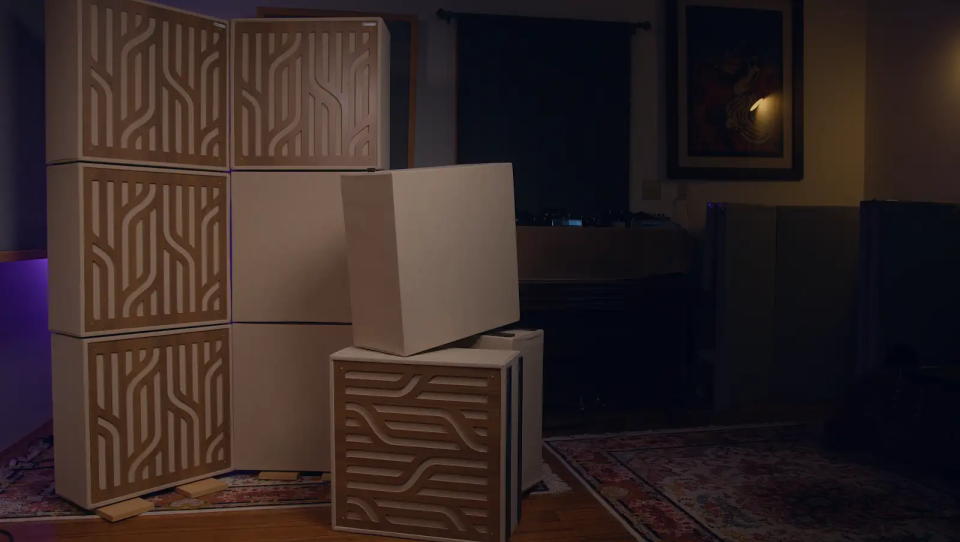
Soffits are designed to stack floor-to-ceiling in corners as freestanding units. They can also be mounted in wall-to-ceiling corners, where additional bass buildup occurs beyond the primary wall-to-wall junctions. You can stack two full size Soffits under an 2.4m ceiling, and with the half-size Demi version you can adjust the stack to height for taller ceilings. They're the reference choice for mastering rooms, high-end control rooms, and serious listening environments where the lowest octaves need to be reliable.
A Range Limiter option is available. This shifts absorption emphasis toward deep bass under 100 Hz while reducing absorption above that range, useful once mid and high frequency control is already well covered elsewhere in the room. Use it selectively. The upper bass range (above 100Hz) is very important, and often it is better to keep full strength performance in this range rather than the lowest frequencies. Consult your GIK Designer for more detailed questions.
TurboTrap Cylindrical Bass Traps

TurboTraps deliver bass control nearly on par with Soffits in a similar footprint, but their cylindrical shape is a better visual match in many rooms, particularly spaces with fewer overall treatments where the look of the device matters. If Soffits have very thick devices right next to them as you'd do in a high end room, they don't look as boxy, but when the corner traps are the only treatments near the corner the TurboTraps often look nicer.
The dual-density material design (patent-pending DDM Technology) is precisely engineered to maximize deep bass absorption from a compact form. TurboTraps are stackable and work equally well in corners or as freestanding units anywhere bass accumulates. At 43cm in diameter and 98cm tall, they're substantial performers in a rounded profile that looks good from every angle.
TriTrap Corner Bass Traps

The TriTrap is GIK's most space-efficient dedicated corner bass trap. Its triangular cross-section fits cleanly into any wall-to-wall corner, taking up minimal floor space while delivering strong broadband absorption. At 57 cm across and available in standard (120 cm tall) or Demi (60 cm tall) sizes, TriTraps are designed to stack floor-to-ceiling, building coverage area vertically in corners where horizontal space is limited. Two full-size TriTraps stack neatly under a normal 2.4m ceiling, and the Demi half-size version lets you fine-tune the stack height to get close to the ceiling in taller rooms.
Standard TriTraps are broadband, absorbing across the frequency spectrum from bass through treble. Add Range Limiters to shift the emphasis toward deep bass absorption below 200 Hz while preserving more of the natural high-frequency energy in the room. This is an outstanding use of corner space, especially in rooms where coverage is growing and there's a risk of overdamping the treble. For recording spaces with acoustic instruments and vocals, leave the Range Limiters off. For critical monitoring environments where low-end accuracy is the priority, Range Limiters are a meaningful upgrade.
Amplitude and SlatFusor Corner Bass Traps

Both the Amplitude Corner Bass Trap and SlatFusor Corner Bass Trap have a similar form factor as the Tri Traps, but bring something different to the corner: the combination of bass absorption and scattering in a single device. These are hybrid units. They absorb, scatter, and provide some diffusion, which means they control bass while simultaneously breaking up the early reflections that would otherwise bounce off an untreated corner surface.
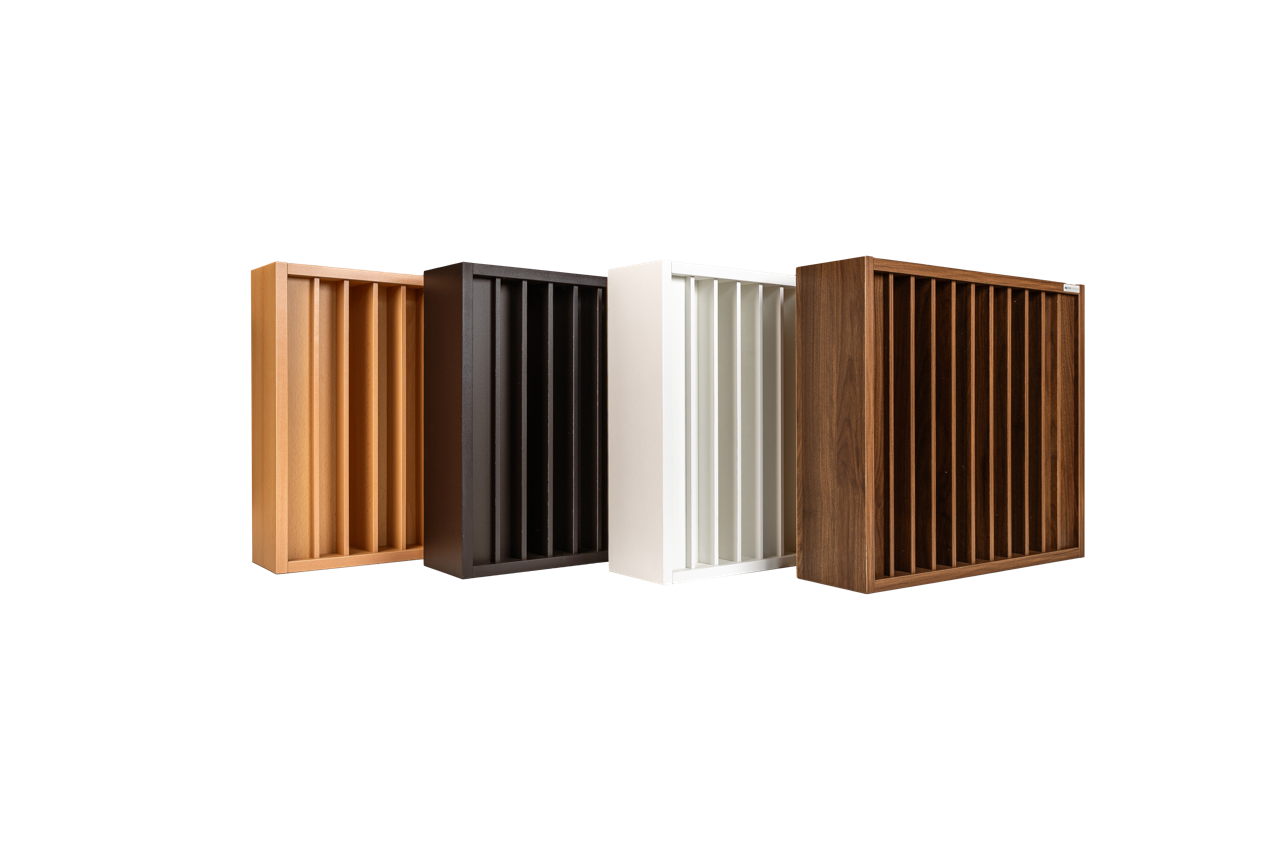
The Amplitude Corner Bass Trap prioritizes acoustic performance, with the Alpha plate patterns. The SlatFusor Corner Bass Trap scatters well and gives some diffusion while prioritizing aesthetics, with a wood-slat face that works beautifully in listening rooms, home theaters, and high-end spaces where the treatment should look intentional. Both are meaningful performers, and both represent a smarter use of corner real estate than bare broadband absorption alone, particularly in the rear corners of a room where scattering toward the listening position has real value, especially in large surround systems with rear & ceiling surround speakers.
FlexRange and Classic Bass Trap Panels in or Across Corners

Thick panel bass traps (particularly the deeper FlexRange Bass Trap Panels and Classic Bass Trap Panels) can be mounted across corners rather than into them, which creates an additional air gap behind the panel and improves low-frequency performance. The 70 Hz FlexRange Bass Trap Panel (18cm thick) and the 50 Hz FlexRange Bass Trap Panel (23cm thick) are especially cost-effective in this role. They cover a wide surface area, they extend absorption well into the bass range, and they're available with Range Limiters for environments that need focused deep bass control without overdamping the room.
If you don't mind doing the installation of the panels across the corners, and don't mind the extra space they take up, this is a very cost-effective way to approach Soffit corner performance at a lower cost. The 60 Hz Classic and 50 Hz FlexRange Bass Trap Panels offer similar deep-bass reach at a lower price point when budget optimization is part of the strategy.
Front and Rear Walls: The Long Dimension
After corners, the front and rear walls (the longest dimension of the room) are the next priority. The room's length defines its lowest axial mode. Energy builds up here and takes the longest to decay. The goal is thick, broadband coverage on both walls.
For the front wall (behind the speakers), thick FlexRange Bass Trap Panels (the 70 Hz or 50 Hz versions) are often the right tools. Range Limiter tuning is worth considering here if the front wall is already handling a lot of reflective duty from speaker placement.
The rear wall deserves a balanced approach: thick bass traps for the lower frequencies, combined with diffusion for the energy that arrives later in time. This is where Amplitude Bass Trap Panels earn their place. They absorb the deep bass while scattering mid and upper-frequency reflections, maintaining the room's sense of space without deadening it. SlatFusor Bass Trap Panels serve the same dual function with a different aesthetic character.
If the room is primarily a critical monitoring environment, prioritize treatment depth on the rear wall to clean up the low end, then fine-tune the mids & highs to taste with Range Limiters or hybrid devices.
Side Walls: Front and Rear Halves Differ
The side walls are not uniform. Treatment strategy changes depending on where you are along the room's length.
In the front half of the room (the zone between the speakers and the listening position), early reflections are the primary concern. These are the fast, loud reflections that smear imaging and cause comb filtering. Thick FlexRange Acoustic Panels and Classic Bass Trap Panels are the correct choice here if we are after the most accuracy. Their broadband absorption handles both the early reflection problem and contributes to overall bass decay control. Thicker is better.
In the rear half of the room (behind the listening position), the reflections arrive later. Here, Amplitude Bass Trap Panels are the better option. They absorb deep bass while scattering later-arriving reflections, which preserves the sense of dimension and prevents the rear of the room from sounding dead. This balance between absorption and scattering is what keeps a well-treated room from feeling sterile.
Ceiling: Often Underused
The ceiling is real estate that many rooms leave completely untreated. That's a mistake. Bass builds up at the ceiling-wall boundaries just as it does elsewhere.
In the front half of the room (above the speakers and listening position), the ceiling is the location for a cloud: thick FlexRange or Classic panels mounted directly overhead. This is one of the most impactful single treatments in a monitoring environment. The improvement to imaging and early reflection control is immediate.
In the rear half, Amplitude Bass Trap Panels extend the treatment's reach while contributing to a balanced, natural decay.
Along the perimeter of the room, at the ceiling-wall corners, Range Limiter-equipped bass traps are worth considering. These corners are often overlooked, but they accumulate bass energy and can contribute to low-frequency ringing that standard wall treatments don't fully address. Covering these ceiling-corner junctions with thick broadband panels (especially Range Limiter variants) rounds out the room's overall bass control in a meaningful way.
Scopus Tuned Membrane Bass Traps: Targeted Precision
Broadband absorption is the foundation. Tuned traps are the refinement.
The Scopus Tuned Membrane Bass Traps are pressure-based absorbers, a fundamentally different mechanism than porous broadband panels. Where broadband traps work across a wide range of frequencies by converting acoustic energy to heat through friction with absorptive material, the Scopus traps use a precisely engineered membrane-and-chamber design to target a very narrow frequency range with high absorption efficiency. Think of it as a drum in reverse: the membrane is tuned to resonate at a specific frequency, absorbing energy right where it's needed rather than across the spectrum.
Scopus traps work to reduce resonances in their very narrow operating range only. They solve any lingering resonance problems, once a comprehensive broadband strategy has been implemented, without affecting frequencies above it.
The best time to use Scopus traps is after the room is already broadband-treated. They are not a substitute for coverage area or thickness. They are a supplement, a targeted tool deployed once measurement reveals persistent resonances that broadband absorption alone isn't fully controlling.
Placement is critical. Scopus traps must go where the pressure mode they're targeting is highest. That almost always means corners and boundaries. If you can't place them where the mode is actually building up, they won't perform. Confirm that the problem frequencies actually have a resonance problem using a time-domain based test like a spectrogram or a waterfall graph. Don't guess at the tuning, and be prepared to experiment with placement in the room to deliver the best results.
GIK offers three Scopus tunings:
Scopus T100
The T100 targets resonances around 100 Hz, which corresponds to room modes driven by an approximately 11-foot dimension. At only 10cm thick, it's the slimmest of the three and works cleanly in spaces where room depth is limited. If you have persistent ringing that broadband treatment hasn't fully resolved, and measurement confirms it's clustering around 100 Hz, the T100 is the right tool.
Scopus T70
The T70 targets approximately 70 Hz, the range corresponding to a roughly 16-foot room dimension. This is one of the most common problem zones in domestic rooms: the modal frequency that produces the classic "one-note bass," where kick drums and bass notes at a specific pitch loom over everything nearby. The T70 shares the same compact 10cm depth as the T100. The effective range extends approximately half an octave above and below the center frequency, so it can catch problems that land close to (but not precisely at) 70 Hz.
Scopus T40
The T40 is a different animal. At 26cm thick, it targets resonances around 40 Hz and below, the sub-bass modes driven by room dimensions of approximately 28 feet or longer. These are the modes that typical broadband absorption struggles most to reach. The T40 is the deepest tool in the Scopus line. It's the right choice when measurement reveals persistent sub-bass ringing in the lowest register that continues to color the room even after thorough broadband treatment.
Because Scopus traps are precision instruments, the consultation process matters here. Confirm that the problem frequencies actually have a resonance problem using a time-domain based test like a spectrogram or a waterfall graph. Confirm the placement via testing and experimentation. If in doubt, contact GIK's design team with measurement data before purchasing. That's the correct path to getting the tuning right.
SoundBlocks: When You Need the Deepest Control

For rooms where the ultimate in low-frequency absorption is the goal (mastering facilities, high-end control rooms, serious listening rooms), SoundBlocks represent the top of the performance hierarchy. Available in both stackable and wall-mount configurations, SoundBlocks are substantial broadband devices designed to address the deep, stubborn modal energy that is difficult to control any other way. Their size and mass give them the physical volume that low-frequency absorption ultimately requires. Space is the currency of low-frequency control. SoundBlocks make that principle literal, with modular, thick devices where the high frequency performance can be configured individually.
Building a Strategy
A complete bass treatment approach follows a logical progression.
Start with the corners. Stack floor-to-ceiling where possible. Use Soffits if you can accommodate the depth, TurboTraps if you need strong performance in a more modest footprint, TriTraps with Range Limiters when space is genuinely limited. Use hybrid corner devices (Amplitude or SlatFusor corner bass traps) where scattering is also needed.
Extend to the front and rear walls with thick panels. Add the ceiling cloud above the listening position. Work the side walls with the right tool for each zone: thick broadband in the front half, hybrid absorption-scattering in the rear.
Measure the room. If persistent resonances remain after substantial broadband coverage is in place, consider Scopus traps targeted to those specific frequencies.
The room will keep improving as coverage area increases. There is no single product that solves the bass problem on its own. It always comes down to how good you need the bass to be, versus how much space inside the room we can use to deliver it. Build toward both ends of that equation deliberately.
Ready to get started? Fill out GIK's Free Acoustics Advice Form and connect with a designer who can guide your specific room.
Share:
Punti di prima riflessione